
| Index | Level 30 April | Level 31 May | Change* |
| S&P 500 | 5035 | 5277 | +4.8% |
| FTSE 100 | 8144 | 8275 | +1.6% |
| Euro Stoxx 600 | 504 | 518 | +2.8% |
| Nikkei 225 | 38405 | 38488 | +0.2% |
| Shanghai | 3104 | 3086 | -0.6% |
| US 10 Yr Treasury Yield | 4.68% | 4.51% | -0.17 |
| UK 10 Yr Gilt Yield | 4.36% | 4.33% | -0.03 |
| Bund 10 Yr | 2.58% | 2.65% | +0.07 |
Equity and bond markets had a positive month, following the declines in April, with some markets attaining new all-time highs during the month and corporate bonds outperforming government bonds, which suggests some optimism from investors on the prospects for global economic growth. This was despite a mixed picture on inflation trends in certain economies. However, all portfolios generated positive returns as a consequence. In the UK, headlines were stolen by the surprise announcement of an election in July, but the markets’ muted reaction suggested investors were not overly concerned.
In dollar terms at least, the US main market more than recovered the losses seen in April, reaching a new all-time high before pulling back. The US economy continues to lead globally, even though GDP figures for the month were reported lower at 3.4%. This number showed that the economy is slowing down, but this in turn led markets to believe that a weaker economy gives room for the Federal Reserve (Fed) to cut interest rates. This optimism was further buoyed by core inflation coming in at a lower than expected 3.4%, with the Fed’s preferred measure, the Personal Consumption Expenditure index (PCE) being in line with expectations. The slower progress on attaining an inflation level of 2%, does suggest that we are likely to see rate cuts until at least September and this has also been suggested by members of the Fed themselves.
On the corporate front, technology giant Nvidia continued to surprise on the upside; reporting earnings ahead of estimates for the sixth consecutive quarter. As a consequence, the technology sector was up over 10% on the month. Nvidia itself is now larger than the entire German stock market on its own and is the biggest single contributor to the S&P 500 this year, accounting for over 30% of the index’ return according to UBS. Notwithstanding this, mid-cap company sector was up almost as much as the larger index and the small cap sector actually surpassed it, in an encouraging sign of a broadening of returns.
Eurozone data continued to improve, with the unemployment rate falling to 6.4% in April, after five months at 6.5%. This was below market forecasts that it would remain at 6.5%. The manufacturing sector has suffered with interest rates higher for longer, but the month’s manufacturing Purchasing Managers Index (PMI) saw a marginal improvement, moving from 45.7 to 47.4. A reading above 50 is positive, so although still in contraction territory, this is the highest reading in 15 months, which is positive. Core inflation surprised as it rose to 2.9%, which was ahead of market expectations of 2.8% and came after nine consecutive months of falling inflation. However, as anticipated, the European Central Bank announced a 0.25% interest rate cut after the month end, but with price pressures remaining, the path of interest rate cuts from here looks uncertain.
Both the stock market and bond markets paid little attention to the announcement of a July election and the potential prospect of a Labour government, largely due to the lack of fiscal borrowing headroom to support unfinanced government spending. Instead, markets were more focused on the current economic backdrop and prospects for lower interest rates, which supported another high for the FTSE 100. The annual inflation rate in the UK eased to 2.3% in April, compared to March’s reading of 3.2%. Despite being slightly higher than market forecasts of 2.1%, this was still a three-year low for inflation and was largely due to the 12% reduction in regulator OFGEM’s energy price cap feeding into the figures. Consumer confidence continued to improve, beating forecasts and reaching its highest level since December 2021. However, the UK’s PMI survey saw a slight pull back in May to 52.8, below the expected level of 54. This was due to a slowdown in services sector PMI as companies continued to adapt to higher interest rates.
Japanese equities traded sideways during May. GDP figures for the final quarter of 2023 were revised down and figures for the first quarter of this year came in at -0.5% (subject to revision). There has been a shift in sentiment towards Japanese stocks, with May seeing money flow out of the market. Japan’s Ministry of Finance confirmed it defended the currency against further weakening at the end of April, buying yen to the tune of $62bn, however the yen remains weak against the US dollar.
In China, the stock market initially responded favourably to the central bank announcing a series of measures to prop up the country’s ailing property sector. These included a 300 billion yuan relending facility established by the bank to help local state-owned enterprises purchase completed but unsold buildings and convert them into affordable housing. However, the market now seems to have shrugged off the aid as inadequate and expects more funding to be required by the end of the year, so the main market ended up in negative territory over the month as a result.
Results elsewhere in Asia were mixed. Taiwan benefitted from its exposure to the silicon chip led technology sector, whilst Korea’s similar exposure failed to prevent a decline.
In emerging markets, elections have been dominating the headlines, as South Africa, Mexico and India all headed to the polls. The final results were all announced after the month end. Mexico elected its first female president with a large majority, suggesting policy continuity, while in India Narendra Modi failed to win the forecast landslide and his BJP party lost its outright parliamentary majority. In South Africa, the nation’s largest party, the ANC, suffered an even greater fall in popularity than expected and will need to form a coalition with a minority party.
Whilst we are clearly now in a period where major central banks are lowering rates, the visibility of cuts and their timing still leads to some caution on the duration (sensitivity to interest rates) front in fixed interest, with this having been reduced within model portfolios in May, in favour of equity exposure. Having performed well, Europe and Japan have been reduced to a more neutral level. Inflation data will continue to dominate both central bankers and investors’ minds alike, as it will ultimately be the trigger for any action on the rates front. The liquidity environment in the US remains favourable, with Quantitative Tightening being tempered and is likely to remain supportive as we head into the Presidential election there.
In our next bulletin, we will know the outcome of the UK general election. However, as previously mentioned, markets seem little troubled by the potential for a change in government – the Labour party seeming to have learnt from Mrs Truss’ experience of attempting to enact unfunded spending plans, which didn’t end well for her.
Rockhold Asset Management, with contribution from Alpha Beta Partners, Marlborough and LGT, June 2024.
IMPORTANT INFORMATION
This document is written by our investment partners Rockhold Asset Management Ltd and its content is for your general information purposes only and does not constitute investment advice. The commentary is intended to provide you with a general overview of the economic and investment landscape. It is not an offer to purchase or sell any particular asset and it does not contain all of the information which an investor may require in order to make an investment decision. We cannot accept responsibility for any loss as a result of acts or omissions taken in respect of this article.
| Index | Level 31 March | Level 30 April | Change* |
| S&P 500 | 5254 | 5035 | -4.2% |
| FTSE 100 | 7952 | 8144 | +2.4% |
| Euro Stoxx 600 | 512 | 504 | -1.5% |
| Nikkei 225 | 40369 | 38405 | -4.8% |
| Shanghai | 3041 | 3104 | +2.0% |
| US 10 Yr Treasury Yield | 4.2% | 4.68% | +0.48 |
| UK 10 Yr Gilt Yield | 3.94% | 4.36% | +0.42 |
| Bund 10 Yr | 2.29% | 2.58% | +0.29 |
Following consecutive monthly returns since the start of the year, we saw a mixed picture in April, with markets that had previously led the way, notably the US and Japan, falling back, resulting in a slight decrease in portfolio values. This was mainly due to expectations over the extent and timing of interest rate cuts in the US, which were clearly previously too optimistic. This particularly impacted lower risk portfolios which have higher levels of bond fund holdings, as we saw bond yields edge up in western economies (bond prices move inversely to yields). It seems that the higher level of economic growth in the US is causing the level of inflation to remain higher than expected, but this situation does not exist in the UK and Europe, so there is every possibility that rates will start to decline here earlier than in the US.
Geopolitics also played a part, as we saw heighted tensions in the Middle East impact sentiment and oil prices as Iran and Israel traded missile and drone attacks on each other’s home soil for the first time. However, as the month drew on fears of further escalation abated and we saw the oil price fall back as a consequence.
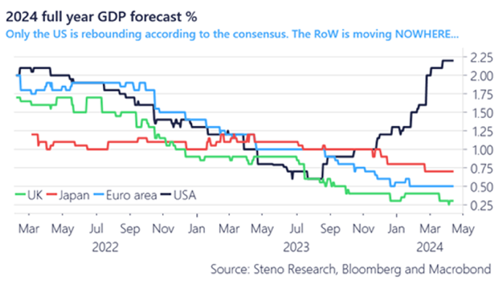
The US economy remains resilient, with a strong job market bolstering consumer spending. Non-farm payrolls and retail sales both came in strong and manufacturing activity ticked into positive territory for the first time since October 2022. First quarter GDP growth increased at a 1.6% annual rate in the first three months of the year. While this is below expectations and lower than the prior quarter, the economy remains robust. This is contrast to the rest of the world (RoW):
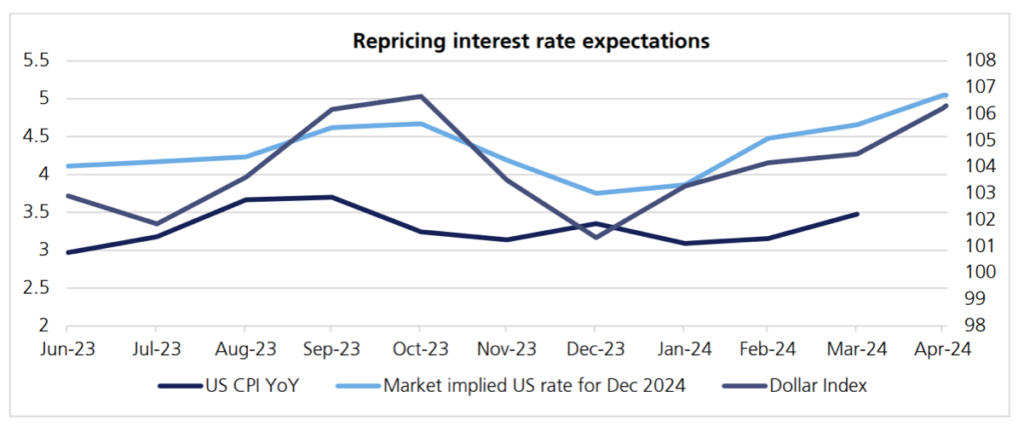
The Consumer Price Index (CPI) data came ahead of expectations at 3.5% year-over-year (YoY), while the Fed’s preferred inflation gauge, the Personal Consumption Expenditures Core Price Index (PCE) remained at 2.8% YoY in March.
These data points indicate inflation remains persistent, which has stalled the Federal Reserve’s (Fed) efforts to combat inflation. Consequently, the Fed will be in no rush to cut rates, and markets are now predicting just one rate cut by year-end, a far cry from the seven rate cuts initially priced in at the end of 2023. This drove 10-year Treasuries up 0.48% to 4.68% in April, while two-year Treasuries closed above 5%.
Broadly, first quarter earnings results have been positive, and going forward the focus is likely to be on margin management, minimising costs in order to maximise profit. Despite this positive sentiment, higher inflation and lower-than-expected GDP growth meant US equities lagged most other regions in April.
Eurozone GDP grew by 0.3% in the first quarter of 2024, which was above market expectations of 0.1% growth and an improvement on the final quarter of 2023. This was largely due to higher-than-expected economic growth in Germany, France, Italy and Spain. Inflation data continues to support the case for the European Central Bank (ECB) to cut interest rates in June. Core inflation, which filters out food and energy prices, eased to 2.7% in April. This was slightly above forecasts of 2.6%, but lower than March’s reading of 2.9%, meaning year-on-year core inflation has now been falling since July.
At home, the UK has seen pleasing reports that inflation is falling towards the Bank of England target with added momentum. The Consumer Prices Index (CPI) rose by 3.2% in the 12 months to March 2024, down from 3.4% to February and well below its recent peak of 11.1% in October 2022. than anticipated. Services inflation remained higher at 6%, primarily due to ongoing wage inflation. The British Retail Consortium reported that food price inflation had fallen to 3.4%, the lowest level in two years. April’s UK consumer price index (CPI) inflation rate is expected to ease further towards 2% as typical energy bills drop by just over 12% after regulator Ofgem reduced the energy price cap to its lowest level in two years. Both consumers and businesses are reacting to the lower inflation environment, as evidenced by consumer confidence hitting a two-year high. Additionally, the UK’s Composite Purchasing Managers’ Index (PMI) survey scored 54, the highest level among G7 countries (a reading of over 50 being viewed as positive for the economy).
The leading UK equity index, FTSE 100 has surpassed an all-time high and the smaller company FTSE 250 has crossed over into an expansionary phase – long overdue but pleasing all the same. Likewise, it is becoming increasingly likely that the Bank of England will move rates lower in coming months.
Japanese equities followed a similar downward trend to US and European equities, with the best-performing sector being larger capitalisation value companies. The focus of investors is now shifting to see if the government steps in to defend the depreciating yen against the US dollar. Recent weakness saw the exchange rate briefly dip to 160 yen to the dollar, with rumours that the Japanese government intervened in the market by buying yen. The exchange rate subsequently corrected back to 155 yen to the dollar. Recent industrial production figures rose by 3.8% (month over month) in March, which was stronger than expected. However, retail sales growth slowed in the same month.
Asia and emerging markets (EMs) outperformed developed markets in April, helped by a strong performance by China, which outpaced the wider EM benchmark as investors became more optimistic about the economic outlook. China is mustering for an aggressive expansion in manufacturing-led exports. Significant debts and bankruptcies in the real estate sector have stymied her post pandemic recovery. Consequently, a move to undercut western rivals in the production of battery electric vehicles and the production of infrastructure and key components in the drive for zero carbon emissions is the ambition. China’s modern automated factories and cheap labour will be supported by a likely currency devaluation making prices to market even more appealing. China’s GDP grew by 5.3% in the first three months of this year and a Bloomberg survey of 15 economists put expectations of GDP growth this year at 4.8%. The People’s Bank of China kept its medium-term lending rate on hold. Latin America is still leading the global monetary easing cycle, although Argentina was the only country to cut rates in April.
In the US, despite high valuations for the large technology companies, earnings are currently supportive and a robust economy helps to underpin corporate performance. This, coupled with the underlying liquidity provided by the US treasury, means that the outlook remains positive and within the MPS, exposure may be increased.
The outlook for Japan remains positive, although again within the MPS, profits may be taken whilst remaining fully invested to harvest further potential upside. The returns from European equities have been impressive, despite recessionary conditions in the major economies. However, prices seem to now reflect the potential ECB rate cuts and like Japan we may see a reduction in our European weighting as a consequence. UK allocation is sitting above the global equity benchmark weighting as we see improving conditions at home whilst valuations are attractive.
We are considering our fixed income duration (sensitivity to interest rates) in portfolios and the potential to adjust such that portfolios benefit from short term rate reductions, but avoid the implications for longer duration as markets realise deep rate cuts, particularly in the US, are less likely.
Rockhold Asset Management, with contribution from Alpha Beta Partners, Marlborough and LGT, May 2024
This document is written by our investment partners Rockhold Asset Management Ltd and its content is for your general information purposes only and does not constitute investment advice. The commentary is intended to provide you with a general overview of the economic and investment landscape. It is not an offer to purchase or sell any particular asset and it does not contain all of the information which an investor may require in order to make an investment decision. We cannot accept responsibility for any loss as a result of acts or omissions taken in respect of this article.